
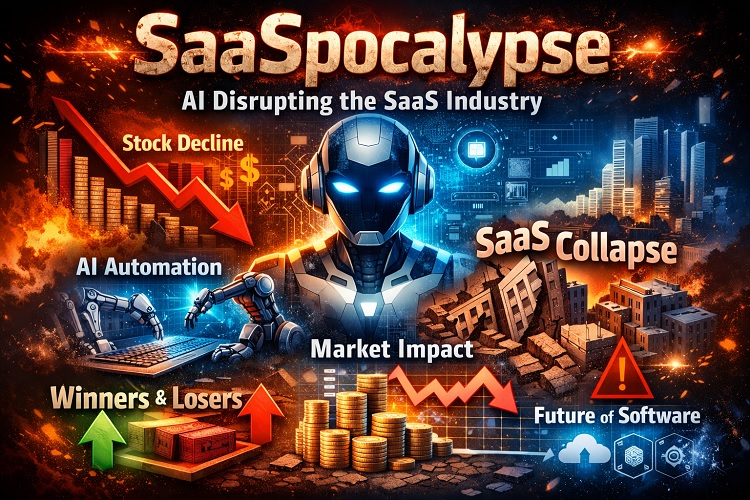
The SaaSpocalypse is changing the software world quickly, and it is driven mainly by artificial intelligence. Today, many SaaS companies face pressure, while investors rethink growth models. As a result, the industry is moving from rapid expansion to a more uncertain phase. Moreover, AI tools now build software faster and cheaper, which directly challenges traditional SaaS platforms.
What Is SaaSpocalypse and Why It Matters
The term SaaSpocalypse describes a major shift in the software-as-a-service market. It refers to falling stock prices, slowing growth, and rising competition from AI-driven solutions.
Earlier, SaaS companies enjoyed steady subscription income and high valuations. However, AI has changed that balance. Now, businesses can create their own tools instead of buying expensive software. Consequently, demand for many SaaS products is weakening.
At the same time, investors are reacting strongly. For example, billions of dollars in market value have disappeared from software stocks. Therefore, the fear is not temporary—it signals a deeper structural change.
How AI Is Fueling the SaaSpocalypse
AI Reduces the Need for Traditional Software
AI tools can now write code, automate workflows, and manage operations. Because of this, companies no longer depend fully on SaaS vendors.
For instance, AI agents can perform tasks like reporting, customer engagement, and analytics. As a result, many SaaS features are becoming easy to replicate.
Moreover, AI lowers development costs significantly. Therefore, startups and enterprises can build custom tools without large budgets.
AI Changes Software Economics
Traditionally, SaaS relied on subscription pricing and user-based licenses. However, AI is pushing the market toward usage-based models.
In addition, AI can replace multiple tools with one intelligent system. Because of this, customers may reduce spending on separate SaaS products.
At the same time, some experts argue the opposite. They believe AI agents could increase software usage and require more licenses. Therefore, the long-term impact remains uncertain.

SaaSpocalypse Winners and Losers
High-Risk SaaS Segments
Certain categories are more vulnerable in the SaaSpocalypse. These include:
- Marketing automation tools
- Productivity software
- CRM add-ons
- Analytics platforms
These tools face risk because AI can easily copy their features. Therefore, their competitive advantage is weak.
More Resilient SaaS Segments
On the other hand, some SaaS sectors remain strong. These include:
- Financial systems
- Healthcare software
- Cybersecurity platforms
These industries require compliance and specialized data. As a result, AI cannot easily replace them.
Furthermore, companies with strong proprietary data and industry focus have better protection. Therefore, they are likely to survive and grow.
SaaSpocalypse and Market Impact
The SaaSpocalypse has already caused major financial shifts.
First, software stocks have dropped sharply in 2026. In many cases, companies lost significant value within months.
Second, investor confidence has weakened. Therefore, funding for SaaS startups is becoming harder to secure.
Third, private equity firms face risks. Some reports warn of revenue declines up to 35% over a few years.
As a result, the industry is entering a correction phase rather than a growth boom.
SaaSpocalypse vs Reality: Is SaaS Really Dying?
Despite fears, SaaS is not disappearing completely. Instead, it is evolving.
Many industry leaders argue that software will remain essential. However, it will move into the background while AI handles user interactions.
For example, AI agents may act as the main interface. Meanwhile, SaaS platforms will operate behind the scenes.
Additionally, large companies continue investing in AI integration. Therefore, they aim to stay relevant in the new environment.
How SaaS Companies Are Adapting
Shift Toward AI Integration
Most SaaS companies are embedding AI into their products. Because of this, they are transforming from tools into intelligent platforms.
For instance, AI assistants can now automate workflows across multiple apps. As a result, productivity improves without manual effort.
New Pricing Models
Companies are also changing pricing strategies. Instead of charging per user, they may charge per task or outcome.
This shift aligns with AI-driven workflows. Therefore, businesses pay for results rather than access.
Focus on Data and Ecosystems
Successful SaaS companies are building strong data ecosystems.
Because proprietary data creates a competitive edge, it protects against AI disruption. Therefore, companies invest heavily in data ownership and integration.
The Future After SaaSpocalypse
The SaaSpocalypse is not the end—it is a transformation.
In the future, software will become less visible. Instead, AI will handle most operations.
Moreover, SaaS companies will act as infrastructure providers rather than standalone tools.
At the same time, competition will increase. Therefore, only companies with strong value propositions will survive.
Key Takeaways on SaaSpocalypse
- AI is the main driver behind the SaaSpocalypse
- Many SaaS tools are becoming replaceable
- However, specialized software remains strong
- Pricing models are shifting rapidly
- The industry is evolving, not collapsing
The SaaSpocalypse marks a turning point in the software industry. While AI disrupts traditional models, it also creates new opportunities. Therefore, SaaS companies must adapt quickly. They need to focus on innovation, data, and integration.
In the end, those who evolve will thrive, while others may disappear.
Reference Source:
This article references insights reported in:
https://finance.yahoo.com/news/saas-saas-driving-saaspocalypse-140000855.html
For More News Click the Links Below:
Shift Away From SaaS Why Companies are Changing Now