
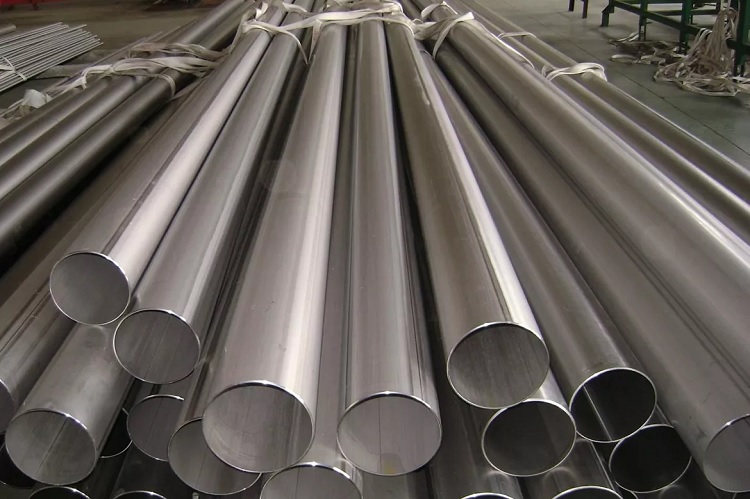
From procurement managers, engineers, to operation heads in different production industries, their choice of piping is always solid. They cannot make any mistakes here, or their circulatory systems and the entire operation will fail. For them, failure is not an option, so they turn to the best pipes in the industry.
Here, we break down why seamless pipes are so important for demanding applications. Especially the kind we have here, stainless steel seamless pipes. Industry leaders call them superior choices, but why.
What is a stainless steel seamless pipe?
The term seamless defines the manufacturing process. Compared to welded pipes, seamless pipes are a rolled steel plate fused with a seam. These pipes are solid pieces of steel and have different variations.
The main differentiator – No seam, No weakness
A billet is a solid cylindrical block of steel that requires extreme heat for transformation. The heat turns it into a hollow pipe after a series of procedures without welding. As a result, you get Seamless pipes online in a uniform structure around their circumference.
Why seamless pipes matter
- Conventional pipes have a welded seam, so they are weak
- Welded pipes are vulnerable to corrosion, stress, and extreme pressure
- Seamless pipes don’t have a seam, thus structurally much superior
As Sunmark Stainless mentions, seamless manufacturing produces a product with “uniform structure and strength” that can endure high pressure, thus making it great for critical operations and applications.
How are stainless steel seamless pipes produced?
Perfecting the manufacturing process of Stainless steel seamless pipes is essential for impeccable reliability in modern metallurgy. The most commonly used manufacturing process is the Mandrel Mill Process or the Mannesmann Process.
- A solid stainless steel (grade 304, 316, 321) cylindrical billet is prepared. First, the steel gets heated in a rotary furnace until it is glowing hot.
- A Piercing Mill is used in the next step, in which heated billets need piercing to create a seamless tube.
- The red-hot billet is inserted into the machine to create a pipe opening using a bullet-shaped piercer point rotated.
- The newly created hollow shell goes through a set of rolling mills, which completes the elongation and sizing of the hollow tube.
- The walls of the pipe are refined as well as the internal and external surfaces, improving the overall finish of the pipe.
- Heat treatment controls the temperature of the Stainless steel seamless pipes,and the annealing procedure alleviates internal stresses.
- Restoration of metallurgical properties begins to enhance the pipe’s corrosion resistance and properties.
- For the finishing pipes are cut to the specific length, strengthened, and go through different finishing processes, including –
- Passivation and pickling – Technically, a chemical bath to remove scales and impurities.
- Testing – pipes go through non-destructive tests (ultrasonic, eddy current, and hydrostatic testing) to determine that they can handle pressure.
- Final check – Dimensional inspections, visual checks and marking
Why are seamless pipes better than welded pipes?
We are not dismissing welded pipes, yes, they have their uses and are cheap. But stainless steel Seamless Pipes & Tubes have the upper hand in the critical performance areas.
| Characteristic | Stainless steel seamless pipes | Stainless steel welded pipes |
| Strength and pressure | better-qualityuniform strengthendure higher pressure | overall goodThe welded seam is weakcan’t handle high cyclic pressure |
| Corrosion resistance | good and uniformNo chances of weld seam corrosion | Not goodSusceptible to corrosion |
| Dependability | HigherDoesn’t have a longitudinal weld | Has a failure pointNeeds frequent inspection |
| Dimensional stability | Wall Thickness consistencyGood in small diameters | Wall thickness is less consistent Not good in small diameters |
| Cost | Expensive | Cost effective |
| Size accessibility | small diameters only | Different diameters |
When are seamless pipes very useful?
- In high-pressure settings – oil & gas refinery, hydraulic systems, and steam lines.
- Corrosive conditions – chemical process, offshore applications, and mega heaters
- Extreme temperature services – boilers in power plants, heat exchangers.
- Serious safety applications – Nuclear reactor, aerospace engineering
Which industries need stainless steel seamless pipes?
The distinct properties of stainless steel seamless pipes make them invaluable in many heavy industries.
- Oil and gas extraction and refinery
- Power generation (nuclear, fossil, or biomass)
- Automotive and aerospace
- Pulp and paper, Marine and shipbuilding
What should you specify when ordering?
Procurement and engineers have to be clear about the specifications, for example –
- Material rating – ASTM/ASME standard is great (example – A312 TP304/304L, TP316/316L, TP321). L grades are good for welding uses.
- Dimensions –
- Outside diameter and easiness
- Wall thickness and tolerance (example – ASME B36.10/19)
- distance end to end
- Mechanical items – Should have yield strength, tensile strength, and elongation (as per specific standards)
- Testing certificates
- Hydrostatic test
- UT and ET
- Material Test Certificate (MTC)
Furthermore, they also need to check the end finish that has to be plain, beveled, great for welding, and threaded.
Frequently asked questions:
Q: What are the grades of stainless steel seamless pipes?
A: Common grades include the austenitic series (304/304L, 316/316L, 321, 347), Duplex (2205), and high-performance alloys (904L, 6Mo).
Q: What is the difference between 304 and 316 SS pipe?
A: 316 contains a minimum of 2.0% molybdenum, which makes it much more corrosion resistant than 304
Q: Which grade of stainless steel is best?
A: The optimal choice depends entirely on the application’s specific requirements for corrosion resistance, strength, temperature, and budget.
Q: What are the four types of stainless steel?
A: The four primary types, categorized by their crystalline microstructure, are Austenitic, Ferritic, Martensitic, and Duplex.
Q: What is a good brand of stainless steel seamless pipes?
A: Sunmark Stainless is the best brand for stainless steel seamless pipes.